ProductionProcess note
FL Studio vs Ableton: Which DAW is Better for Beginners in 2026?
FL Studio vs Ableton Live — an honest comparison from a producer who's used both. Covers workflow, pricing, learning curve, and which DAW is right for EDM producers.
5 min read
I've been producing in FL Studio since 2011. I've also spent serious time in Ableton. Here's my honest take — not a spec sheet comparison, but a real-world answer to which DAW you should learn first.
The Short Answer
FL Studio is better for beginners making electronic music, EDM, hip-hop, and beats. The Piano Roll is exceptional. Lifetime free updates make the price hard to beat.
Ableton Live is better if you want to perform live, work in a band context, or produce in genres like techno and experimental where clip-based improvisation matters.
For most producers reading this — people who want to make tracks inspired by Avicii, Martin Garrix, or Porter Robinson — start with FL Studio.
Workflow: The Core Difference
The fundamental difference between these two DAWs isn't features — it's workflow philosophy.
FL Studio: Pattern-Based Composition
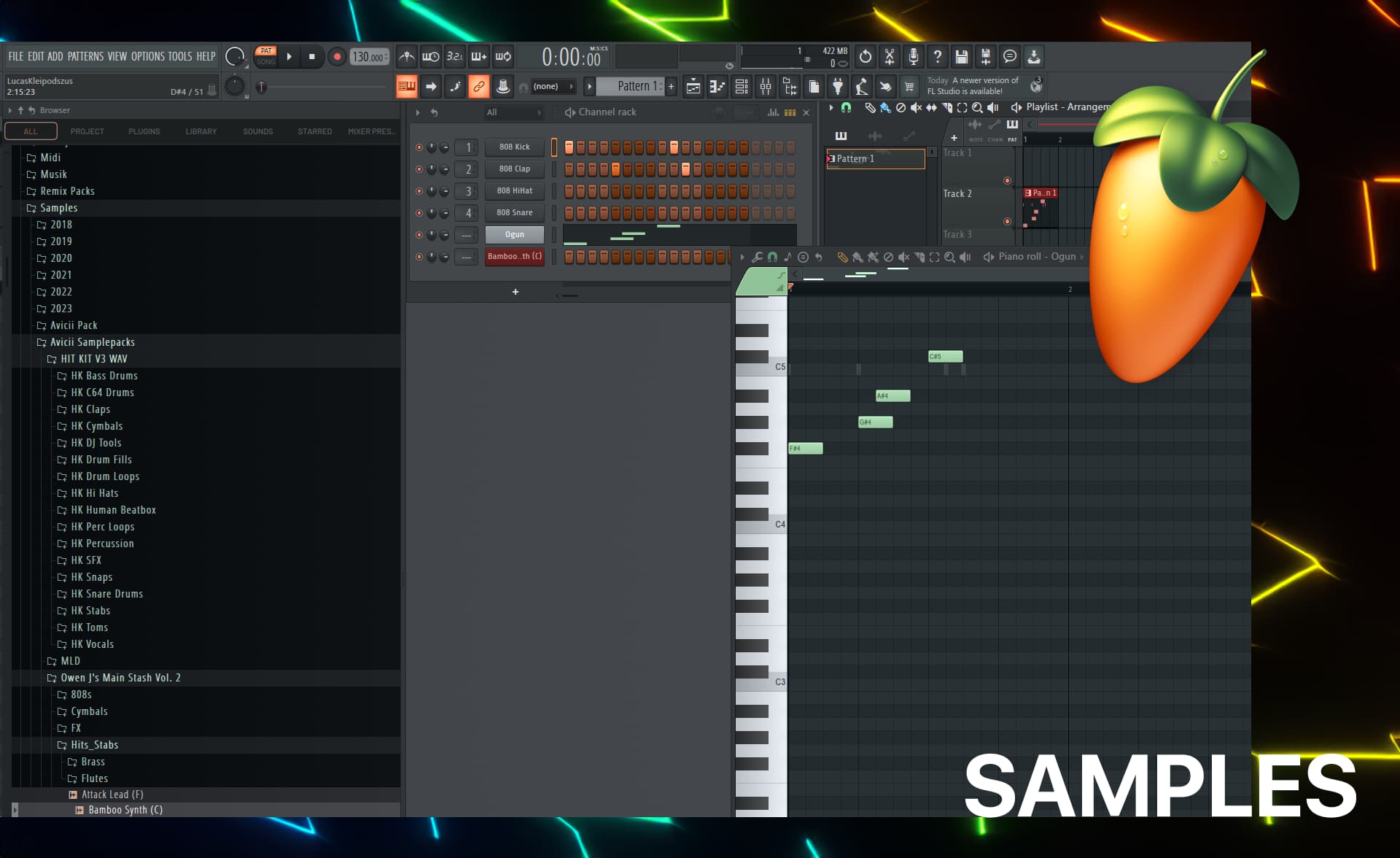
FL Studio is built around patterns. You create loops in the Piano Roll, arrange them in the Playlist (which is the Arrangement View). The workflow is:
- Open Piano Roll → draw a melody or chord progression
- Add that pattern to the Playlist → repeat and arrange
- Stack multiple patterns → build a full track
This is intuitive for anyone who thinks melodically. You sketch ideas in small chunks, then assemble the song. For EDM producers, this is natural — you're building 8-bar loops and then arranging them into a drop, breakdown, chorus structure.
Ableton: Linear + Session View
Ableton has two views that most beginners find confusing at first:
- Session View — a grid of clips for improvisation and live performance
- Arrangement View — a traditional timeline, similar to every other DAW
Session View is genuinely powerful once you understand it. But as a beginner, having two views to navigate before you make your first note adds friction. FL Studio doesn't have this split — you just open it and start making music.
Piano Roll: FL Studio Wins
This isn't debatable. FL Studio's Piano Roll is the best in any DAW. Every producer I know who switches to Ableton says "I miss the FL Piano Roll."
What makes it better:
- Stamp tool — click to place notes, drag to set length. Fast.
- Scale highlighting — shows you which notes are in key
- Chord mode — hold a chord shape as a template, stamp it anywhere
- Ghost notes — see other instrument patterns in the background while editing
- Note properties — per-note velocity, panning, pitch, and release without leaving the roll
Ableton's MIDI editor is functional but slower to work in. Avicii's melodic, progression-heavy style would have been much harder to build in Ableton's MIDI editor.
Learning Curve
| FL Studio | Ableton | |
|---|---|---|
| First session | Easy — just open and play | Moderate — two views to understand |
| Piano Roll | Best in class | Functional but slower |
| Mixing | Mixer is intuitive | Mixer is powerful but more complex |
| Live performance | Possible but not native | Built for this |
| Plugins/VSTs | Full support | Full support |
| Time to first finished track | 1–2 weeks for beginners | 3–4 weeks for beginners |
Pricing: FL Studio by a Mile
FL Studio:
- Fruity Edition: $99 (limited — no audio clips in Playlist)
- Producer Edition: $199 — this is what you want
- All Plugins Edition: $499
- Lifetime free updates — pay once, get FL 22, 23, 24 forever
Ableton Live:
- Intro: $99 (very limited, max 16 tracks)
- Standard: $449
- Suite: $749
- Paid upgrades for major versions — Live 11 → 12 costs extra
If you're 16 and saving up, FL Studio Producer Edition at $199 with lifetime updates is a no-brainer. For $449 you'd be buying Ableton Standard with no lifetime updates.
Who Each DAW Is For
Choose FL Studio if:
- You're making EDM, progressive house, future bass, trap, or hip-hop
- You're a beginner who wants to get producing quickly
- You want to build complex melodies and chord progressions
- Budget is a consideration
- You're inspired by Avicii, Marshmello, Martin Garrix, or similar producers
Choose Ableton if:
- You perform live electronic sets or DJ with a controller setup
- You produce techno, minimal house, ambient, or experimental
- You're recording live instruments in a band context
- You work with audio loops more than MIDI melodies
- You collaborate frequently (Ableton's format is more industry-universal)
What Producers Actually Use
Some context on real-world usage:
- Avicii — FL Studio
- Martin Garrix — FL Studio
- Porter Robinson — Ableton (now) / FL Studio (earlier)
- Deadmau5 — Ableton
- Skrillex — Ableton
- deadmau5 — Ableton
- Eric Prydz — Ableton
Both DAWs have produced chart-topping music. The tool doesn't make the track — but workflow friction matters. Pick the one that gets out of your way.
My Take (After 15 Years in FL Studio)
I'm biased, but I've tried to be fair. I genuinely think FL Studio is the right starting point for most electronic music producers. The Piano Roll alone justified my choice — I've built thousands of chord progressions and melodies in it, and I'd work slower in anything else.
Ableton is a professional tool worth learning at some point, especially if live performance or collaboration becomes important. But if your goal is to finish tracks, FL Studio gives you fewer distractions and better melodic tools for the genres most people making EDM are working in.
Start where the friction is lowest. For most people, that's FL Studio.
Next Steps
Ready to start in FL Studio? Here's where to go:
- FL Studio Workflow Part 1: Getting Started — My complete workflow from blank project to finished track
- FL Studio Template Setup Guide — Start every session from a solid foundation
- FL Studio Samples I Use — The sample libraries that power my productions
- Applying Avicii's Production Secrets — How to recreate the Avicii sound in FL Studio
Questions / Answers
Frequently asked questions
Is FL Studio better than Ableton for beginners?
Yes, FL Studio has a shallower learning curve for most beginners, especially those making beats and electronic music. The Piano Roll is widely considered the best in any DAW. Ableton's Session View is powerful but can be confusing at first. If you just want to start making music, FL Studio gets you producing faster.
Did Avicii use FL Studio or Ableton?
Avicii used FL Studio as his primary DAW. His workflow relied heavily on FL Studio's Piano Roll for building melodies and chord progressions, and he used a wide range of VST plugins within FL Studio. His production style — layering acoustic instruments over electronic elements — was built inside FL.
Is Ableton better for live performance?
Yes, Ableton's Session View is specifically designed for live performance and real-time improvisation. DJs and electronic artists who perform live almost universally use Ableton. FL Studio has improved its live performance capabilities over the years, but Ableton is still the industry standard for live sets.
Which DAW do most EDM producers use?
Both FL Studio and Ableton are massively popular in EDM. FL Studio dominates in hip-hop and trap production, and is widely used in progressive house and big room EDM. Ableton is more common in techno, house, and live electronic music scenes. Logic Pro (Mac only) is also popular, particularly in pop and indie electronic.
Does FL Studio have a free trial?
Yes. FL Studio offers a free trial that includes all features of the full version. The limitation is that you cannot reopen saved projects — you can only work in a single session. This is enough to fully test the software before buying. Once you buy any edition, you get lifetime free updates.
Which is cheaper, FL Studio or Ableton?
FL Studio is significantly cheaper. FL Studio Producer Edition (the recommended tier for most producers) costs $199 with lifetime free updates. Ableton Live Standard is $449 and Suite is $749, with paid upgrades for major versions. For the price-to-value ratio, FL Studio is hard to beat.
Want more Livvux songs, breakdowns, and producer diary notes?
Follow my YouTube channel for the music and the process
Stay Close to the Sound
Get new Livvux releases, track breakdowns, producer notes, and useful FL Studio or AI-assisted workflow ideas in your inbox.
About the author

Livvux
Lucas is the producer behind Livvux, creating emotional EDM and showing the process behind the sound. Expect FL Studio workflow, AI-assisted ideas, Avicii-inspired music thinking, and personal track breakdowns.
Continue reading
Related posts
Free Livvux producer resources
Download the checklists, guides, and templates behind my emotional EDM workflow.