ProductionProcess note
Music Theory for EDM Part 1: The Fundamentals Every Producer Needs
Master essential music theory concepts for electronic music production. Learn scales, chord progressions, harmony, and rhythm fundamentals specifically applied to EDM and modern electronic music.
11 min readUpdated
Music Theory for EDM Part 1: The Fundamentals Every Producer Needs
Welcome to the Music Theory for EDM series! Whether you're a complete beginner or have been producing for years, this three-part series will give you the practical music theory knowledge you need to create better electronic music.
What this series covers:
- Part 1 (This Article): Fundamentals - Scales, keys, and basic harmony
- Part 2: Chord Progressions - EDM's most powerful patterns
- Part 3: Melody and Bass - Writing memorable hooks and solid low-end
By the end, you'll have a complete understanding of music theory specifically applied to EDM production.
Why Music Theory Matters in EDM
The Practical Advantage
Theory isn't academic exercises—it's creative fuel.
When you understand music theory:
- You can create chords that evoke specific emotions
- You can write melodies that stick in listeners' heads
- You can create tension and release in your arrangements
- You can communicate better with vocalists and collaborators
What Most Successful Producers Know
Top EDM producers may not think "music theory" while producing, but they use it intuitively because they've internalized:
- Chord relationships (what sounds good together)
- Scale knowledge (which notes work in which context)
- Harmonic principles (voice leading, resolution)
- Rhythmic patterns (what feels right for dance music)
Understanding Scales
What is a Scale?
A scale is a sequence of notes ordered by pitch. The scale defines:
- Which notes you can use
- Which notes sound "in key"
- The tonal center of your music
The Major Scale (EDM's Foundation)
C Major Scale: C D E F G A B
C → D → E → F → G → A → B → CWhy it works:
- Bright, happy, uplifting sound
- Perfect for House, Trance, Progressive House
- Most common key in EDM (25% of tracks)
In practice:
- Main chords: C major, F major, G major
- Leads: C major pentatonic (C D E G A C)
- Bass: Root notes of C major scale
The Minor Scale (Emotional Depth)
C Minor Scale: C D E♭ F G A♭ B♭
C → D → E♭ → F → G → A♭ → B♭ → CWhy it works:
- Sad, melancholic, emotional
- Perfect for Trance, Deep House, DnB
- Second most common key in EDM (20% of tracks)
In practice:
- Emotional chords: A minor, D minor, E minor
- Leads: C natural minor pentatonic
- Bass: C, D, F foundation
The Pentatonic Scale (Your Best Friend)
What makes pentatonic special:
- Only 5 notes vs. 7 in major/minor
- Creates stronger melodies
- Used in 80% of popular music
Major Pentatonic: Root + 2, 3, 4, 5, 6, 7
C Major Pentatonic: C D E G A
Use when: You need simple, catchy melodies Famous examples:
- Avicii "Wake Me Up" (uses C major pentatonic heavily)
- Swedish House Mafia "Don't You Worry Child" (C major)
- Calvin Harris "Feel So Close" (C major)
Minor Pentatonic: Root + 2, 3, 5, 6, 7
C Minor Pentatonic: C D♭ E♭ F G A♭ B
Use when: You want emotional, melancholic melodies Famous examples:
- Tiësto "Adagio for Strings" (uses D minor)
- Above & Beyond "Sun & Moon" (uses B minor)
- Deadmau5 "Remember Me" (uses C minor)
Scale Degree Formula
Understanding scale degrees for building chords:
| Degree | Note (C Major) | Function | Chord Quality |
|---|---|---|---|
| 1 | C | Root (Tonic) | Major |
| 2 | D | Supertonic | Major |
| 3 | E | Mediant | Minor |
| 4 | F | Subdominant | Major |
| 5 | G | Dominant | Major |
| 6 | A | Submediant | Minor |
| 7 | B | Leading tone | Diminished |
Building chords from scale degrees:
- 1 + 3 + 5 = Major triad (C - E - G)
- 2 + 4 + 6 = Minor triad (D - F - A)
- 1 + 3 + 5 + 7 = Major 7th chord (C - E - G - B)
Intervals: The Building Blocks
What Are Intervals?
An interval is the distance between two notes. Understanding intervals helps you:
- Create harmonic movement (basslines, arpeggios)
- Design synth leads with the right character
- Create tension and resolution
- Build memorable hooks
The Most Important Intervals in EDM
3rd (Major & Minor):
- Major 3rd (C → E): Happy, bright, uplifting
- Minor 3rd (C → E♭): Sad, emotional, melancholic
- In EDM: Used constantly in leads and melodies
5th:
- Perfect 5th (C → G): Open, stable, resolute
- Diminished 5th (C → G♭): Tense, creates desire for resolution
- In EDM: Creates movement in bass and leads
7th:
- Major 7th (C → B): Bright, colorful
- Minor 7th (C → B♭): Sophisticated, emotional
- In EDM: Essential for House and Trance leads
Octave (8th):
- Same note, one octave apart
- Reinforces the tonal center
- In EDM: Used for bass and pads
Interval Recognition Training
Ear training approach:
- Learn a reference song by ear
- Identify the intervals between chords
- Try singing the intervals
- Apply in your own productions
Common EDM interval patterns:
- Bass octaves (C → C) - grounding
- Lead 3rds and 5ths - melodic movement
- Rising sequences (C → D → E → F) - building tension
- Falling sequences (F → E → D → C) - resolution
Keys and Their Emotional Characteristics
The Circle of Fifths
Understanding how keys relate to each other:
        F# → C → G → D → A → E → B → F# → C
          ↗          ↗          ↗          ↗
Clockwise (up in circle) = Major keys (bright) Counter-clockwise (down in circle) = Minor keys (dark)
Key Characteristics for EDM
| Key | Character | Best Genres | Famous Examples |
|---|---|---|---|
| C Major | Bright, uplifting, universal | Avicii "Levels", Swedish House Mafia | |
| D Major | Bright, triumphant, warm | Calvin Harris, Martin Garrix | |
| E Major | Bright, triumphant, epic | Daft Punk, Deadmau5 | |
| F Major | Warm, rich, grand | Kaskade, Alesso | |
| G Major | Bright, energetic, driving | David Guetta, Nicky Romero | |
| A Major | Bright, hopeful, clear | Zedd, Hardwell | |
| A Minor | Sad, emotional, melancholic | Avicii "The Nights", Tiësto | |
| D Minor | Dark, mysterious, tense | Swedish House Mafia "Antidote", Deadmau5 | |
| E Minor | Dark, intense, dramatic | Deadmau5 "Greyhound" | |
| B Minor | Dark, serious, heavy | Avicii "Seek Bromance" |
Key Selection Strategy
Choose your key before producing:
- Listen to references in different keys
- Match the mood of your track
- Consider vocalist range (if using vocals)
- Use scale knowledge to compose faster
Quick reference:
Uplifting/Festival: C Major, D Major, G Major
Emotional/Melancholic: A Minor, D Minor, E Minor
Dark/Aggressive: D Minor, E Minor, B Minor
Chord Basics
What Makes a Chord?
A chord is three or more notes played simultaneously. In EDM, chords typically have:
- Root: The tonal center
- Third: Defines major or minor quality
- Fifth: Creates stability or tension
The Major Triad
Formula: Root (1) + Major 3rd (3) + Perfect 5th (5)
Example: C Major
- Notes: C - E - G
- Sound: Bright, stable, happy
Where to use in EDM:
- Chord progressions that feel uplifting
- House and Trance music
- Pad and chord stabs
The Minor Triad
Formula: Root (1) + Minor 3rd (3♭) + Perfect 5th (5)
Example: C Minor
- Notes: C - E♭ - G
- Sound: Sad, emotional, tense
Where to use in EDM:
- Trance breakdowns
- Deep House atmosphere
- Emotional vocal tracks
The Diminished Chord (Tension Creator)
Formula: Root (1) + Minor 3rd (3♭) + Diminished 5th (5♭)
Example: C Diminished
- Notes: C - E♭ - G♭
- Sound: Tense, unstable
- Use: Before resolving to a stable chord
Chord Inversions
Root Position (Standard)
C Major Root Position: C - E - G
- C is the lowest note
- E and G are above
- Use: Foundation of your progression
First Inversion
C Major First Inversion: E - G - C
- E is the lowest note
- Creates different color/voice
- Use: Basslines and mid-range chords
Second Inversion
C Major Second Inversion: G - C - E
- G is the lowest note
- Most common inversion in EDM bass
- Use: Bass lines and low synth chords
Inversions in Practice
Inversion strategy for EDM:
- Start with root positions for foundation
- Use first inversions for bass movement
- Use second inversions for bass lines
- Keep bass in root position for clarity
Putting It Together: Your First Theory-Based Track
Practice Exercise
Create a simple 4-bar progression in C Major:
Bar 1: | C Maj (Root) | F Maj | C Maj | F Maj | C Maj
Bar 2: | G Maj        | C Maj | F Maj | C Maj
Bar 3: | F Maj        | A Min | G Maj | F Maj
Bar 4: | C Maj (Root) | G Maj | A Min | F Maj
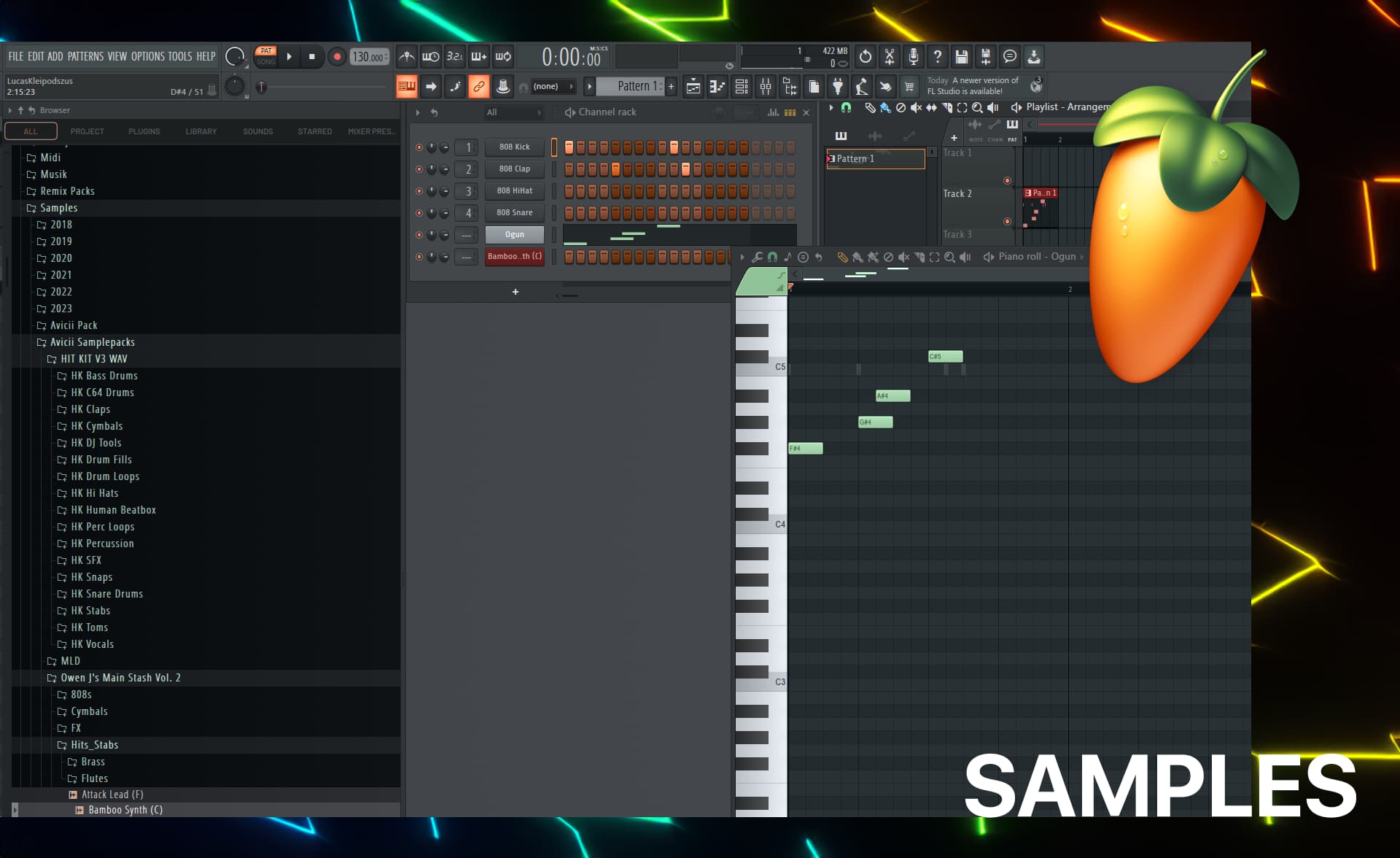
Step-by-Step in FL Studio
- Set BPM: 128 (typical for House)
- Create instruments:
- Synth 1: C Major chord (sawtooth, 8 voices)
- Synth 2: F Major chord (square)
- Bass: C major triad
- Program pattern:
- Bar 1: C Major triad - play for 2 beats
- Bar 2: C Major triad - play for 2 beats
- Bar 3: Switch to F Major - play for 2 beats
- Bar 4: Return to C Major - play for 2 beats
- Add movement:
- Add slight filter sweep on bar 3 (F Maj → A Min → G Maj)
- Add reverb send automation
- Listen and refine:
- Do the chords resolve?
- Is the progression smooth?
What You've Learned
Theory concepts applied:
- Major scale (C Major) for bright, uplifting feel
- Major triads for stable, happy chords
- One minor chord (A Min) for emotional tension
- Proper resolution (A Min → G Maj → C Maj)
Rhythm Fundamentals
Understanding Time Signatures
Common EDM time signatures:
| Time Signature | Beats Per Bar | Subdivision | Best For |
|---|---|---|---|
| 4/4 | 4 beats | Quarter notes | House, Techno, Trance |
| 3/4 | 3 beats | Quarter notes | Progressive House |
| 2/4 | 2 beats | Half notes | Deep House, DnB |
4/4 time signature (most common):
Count: 1  2  3  4  (repeat each bar)
1  +  2  +  3  +  4
Beat Patterns
Kick pattern (foundation):
Kick: X . . . X . . . X . .Hi-hat pattern (energy):
Hats: X . X . X . X . X . X . X . X . (16th notes)Snare pattern (backbeat):
Snare: . . X . . . X . . . X . (on beat 3)Syncopation (The "Groove" Element)
Basic syncopation:
Straight: X . X . X . X . X . X . (house)
Swing: X . X ( . . ) X . ( . X (house, funk)
In FL Studio:
- Use swing dial in channel rack
- Set groove template in FPC
- Or manually offset notes by FL ticks
Voice Leading
What is Voice Leading?
Voice leading is how smoothly one chord moves to another. Good voice leading makes your music sound natural and professional.
The Rules of Voice Leading
1. Common tone moves by step (2nd)
Good:  C → D → E  (all move to nearest chord tone)
Avoid:  C → F♯ → G♭ (chromatic movement feels weird)
2. Resolve tendency tones
7th chords resolve down a 5th
C Maj 7 (B) → F Maj (root)
C Min 7 (B♭) → F Maj (root)
3. Don't leap large intervals
Good: C → E (3rd), then E → G (2nd)
Avoid: C → G (5th), then G → B♭ (tritone jump)
4. Keep common tones
When switching chords, keep one note the same.
C Maj → F Maj (keep E common) → G Maj (keep G common)
Voice Leading in Practice
Create a progression that follows the rules:
C Maj (root) → A Min (ii) → D Min (iii) → G Maj (IV) → C Maj (V)Analysis:
- C to A: Common tone (C), moves up by step ✓
- A to D: Common tone (A), moves down by step ✓
- D to G: Common tone (D), moves down by step ✓
- G to C: Perfect 5th to root, resolves strongly ✓
- No awkward chromatic movements ✓
Result: Natural, flowing progression
Practical Ear Training
Interval Ear Training
Daily 5-minute exercise:
- Listen to a reference track in C Major
- Identify the intervals:
- Can you hear the 3rds (C → E, F → G)?
- Can you hear when the 5th appears (C → G)?
- Sing the intervals to internalize them
- Reproduce with your synth or instrument
App: "EarMaster" or similar ear training app
Chord Progression Ear Training
Exercise:
- Listen to a chord progression
- Try to identify the chord types (Major, Minor)
- Sing the bass note
- Practice until it becomes natural
Method:
- Start with simple progressions (I - IV - V - I)
- Use well-known tracks as examples
- Analyze in your DAW to confirm
Music Theory Tools
FL Studio Plugins
Built-in tools for theory:
-
Piano Roll - Visual representation of scales and intervals
- Right-click → "Scale" to highlight notes in key
- Color code scale degrees (root, 3rd, 5th)
-
Riff Machine - Create melodies from scale constraints
- Set scale and key
- Generate random melodies
- Analyze and learn patterns
-
Fruity Looper - Study chord voicings
- Load chord progression
- Experiment with inversions
- Analyze common patterns
External Plugins (Optional)
Chord recognition:
- Scaler 2: Shows all scales in any key
- Tonesphere: Visual circle of fifths
Ear training:
- Complete Ear Trainer: Customizable exercises
- Melody Ear Training: Melodic dictation practice
Your Action Plan
This Week's Goals
Day 1-2: Scale mastery
- Practice C Major and A Minor scales in piano roll
- Learn intervals by ear (3rds, 5ths, octaves)
- Identify key of 5 favorite tracks
Day 3-4: Chord practice
- Build 10 chord progressions in C Major
- Experiment with inversions
- Practice voice leading (resolution rules)
Day 5: Analysis
- Analyze 3 reference tracks for chord progressions
- Note the scale degrees used
- Identify emotional movements
Day 6-7: Application
- Use a C Major scale in a new track
- Build a 4-bar progression
- Add bassline following chord tones
Day 8+: Practice daily
- 10 minutes of ear training daily
- Analyze one track per day
- Apply one new concept per track
Download These Resources
Free tools for learning:
- FL Studio Template - Professional project setup
- Music Production Checklist - Ensure you don't miss steps
- Suno AI Masterclass - AI music generation
Next Steps
In Part 2 of this series, you'll learn:
- Advanced chord progressions for EDM
- Extended chords (7ths, 9ths)
- Modal scales for more interesting melodies
Continue to Part 2: Chord Progressions →
Questions?
What music theory topics are you struggling with? Let me know in the comments or reach out on social media!
- YouTube @livvux for video tutorials
- Instagram @livvux for daily tips
Ready to understand music on a deeper level? Let's dive in!
Questions / Answers
Frequently asked questions
Do I need to know music theory to produce EDM?
Not necessarily to get started, but understanding music theory dramatically improves your productions. It helps you understand why certain chords work better, how to create emotional tension and release, and gives you a vocabulary to communicate with other musicians and understand music more deeply.
Is music theory difficult to learn?
It can seem intimidating at first, but you only need to master a few core concepts that you use repeatedly. Start with practical application in your productions rather than memorizing complex academic theory. Learn one concept, apply it in your music, then move to the next.
What scales should I learn first for EDM production?
Start with Major and Minor scales, then add the modes (Dorian, Phrygian, etc.). Major and Minor scales are used in probably 80% of EDM, especially House and Trance. Master these first before diving into more exotic scales.
How do I choose the right key for my track?
The key determines the emotional character of your track. For uplifting EDM, keys like C major, F major, and G major sound bright and energetic. For darker or more melancholic tracks, consider A minor, D minor, and E minor. Listen to reference tracks in different keys and learn their character.
Want more Livvux songs, breakdowns, and producer diary notes?
Follow my YouTube channel for the music and the process
Stay Close to the Sound
Get new Livvux releases, track breakdowns, producer notes, and useful FL Studio or AI-assisted workflow ideas in your inbox.
About the author

Livvux
Lucas is the producer behind Livvux, creating emotional EDM and showing the process behind the sound. Expect FL Studio workflow, AI-assisted ideas, Avicii-inspired music thinking, and personal track breakdowns.
Continue reading
Related posts
Free Livvux producer resources
Download the checklists, guides, and templates behind my emotional EDM workflow.